Showing posts with label deck building. Show all posts

Wednesday, March 12, 2014

Deck Check: Shadow Paladins - Revengers (Raging Form Dragon)

Deck Check: Revengers (Shadow Paladins)


BT12 - Binding Force of the Black Rings marked the debut of the highly awaited new clan of Link Joker ( along with their "locking" mechanic) and the Яeverse support for Narukami, Pale Moon, and Dark Irregulars, that also came with it  in this set. Along these also, is the more anticipated return and upgraded support for Shadow Paladins: the Revengers archetype. They made their debut weeks before set 12's release when TD10 and TD11 was released, and they set to mark their territory in the meta with their optimal boss card, "Revenger, Raging Form Dragon" (RFD). So without any further a do, let us begin:


It is very generic and is a must to run four (4) copies of the Revengers Breakride, "Illusionary Revenger, Mordred Phantom" and the deck's boss card, "Revenger, Raging Form Dragon" (RFD). You need to maximize the number of copies of RFD in your deck in order to have a higher chance of drawing in to it and be able to activate its limit break. Also, the same reason goes for Mordred Phantom. Running four (4) copies of him is very essential to the deck and in some sense,a trivial aspect for the deck to work properly. 


For the grade 2's, four (4) of "Blaster Dark Revenger" and "Nullity Revenger, Masquerade", and three (3) copies of "Dark Cloak Revenger, Tartu" are run by me. There aren't really other grade 2 units for revengers which prove to be better than these. Albeit some players opt to run Rugos (10k Vanilla) instead of Tartu, mainly because this deck can sometimes be counter-blast heavy, and Rugos aids in diminishing that and provide a solid 10k body. But why should you run Tartu?  In contrast to Rugos, Rugos does not help you in 'shaping' up your field. He only provides a beatdown power, WHICH is only 1k more than Tartu. Tartu on the other hand, aids you in shaping and forming up the structure of your playing field. She can get any grade 1 or lower "Revenger" unit from your deck and place it on the same column as hers. "But for the cost of two (2) counterblasts, is it worth it?" The answer to that question will only depend on what you are going to call. You don't use her skill too often or when you have nothing good to call on. But the efficient aspect I see to this is when you choose to superior call a "Barrier Troop Revenger, Dorint", and in the following turns assuming Tartu gets retired or intercepted, when you call and replace her with "Blaster Dark Revenger", you basically got your superior call (i.e. Dorint) for the cost of only one (1) counterblast.


On to the grade 1's: four copies (4) "Barrier Troop Revenger, Dorint" and "Dark Revenger, Mac Lir" (PG) are run along with three the (3) copies of  the the grade 1 revenger 10k attacker, "Transient Revenger, Masquerade" and two (2) "Revenger, Dark Bond  Trumpeter". Also, the last of the normal units for this deck is the second copy of our starting vanguard, "Frontline Revenger, Claudas". Four (4) copies of the Perfect guard (Mac Lir) and Blaster Dark's tandem, Dorint is highly recommended for this deck, simply because the former is relevantly needed to stop the onslaught of the high numbers of attack power that vanguards can unleash out in this breakride format  (especially noted of this is Link Joker) and the latter is going to be your generic grade 1 booster on your field (and also unflips damage with Blaster Dark). For Masquerade, in contrast as to most of the clans who bring four (4) copies of the same kind as him, three (3) copies of him is just the most that you can bring in this build. This is because the last two (2) slots available is left for Dark Bond Trumpeter. Dark bond trumpeter is mainly used as a fodder for Raging Form's skill and is also Claudas' retriever. She gets you your second copy of Claudas for the cost of one (1) counterblast. 


If any of you know the 2013's Fighter's Climax National Champion of Japan (Open Division), Lee Innyeng  who won using the Shadow Paladin clan, you might've noticed that this is EXACTLY the same lineup and build as his; true. But this deck (of mine) is only different in the trigger line-up. As you can see, I'm running nine (9) Critical Triggers. Yes. NINE Critical Triggers. To some of you, you wouldn't really react as much to this, while others may (and most like will) scrutinize this. The standard trigger line-up for Revengers has always been 8 Crits, 4 Draws, and 4 Heals. However, this is too predictable already and as such I decided to take it up a notch and increase the possibilities of my vanguard checking in to a critical. This was mainly done for the purpose of surprise and is not recommended (by me) to be run for consistency purposes.


Complete Deck List:
Grade 0 (18) :
2x  Frontline Revenger, Claudas (not shown in the picture above)
1x  Grim Reaper
4x  Grim Revenger
4x  Revenger, Air Raid Dragon
3x  Freezing Revenger
4x  Healing Revenger

Grade 1 (13) :
4x  Barrier Troop Revenger, Dorint
4x  Dark Revenger Mac Lir
3x Transient Revenger, Masquerade
2x  Revenger, Dark Bond Trumpeter

Grade 2 (11) :
4x  Blaster Dark Revenger
4x  Nullity Revenger, Masquerade
3x  Dark Cloak Revenger, Tartu

Grade 3 (8) :
4x  Illusionary Revenger, Mordred Phantom
4x  Revenger, Raging Form Dragon


Overall, the Revengers have proven to be a very resilient deck in the japanese meta by staying in it for more than 6 months already and has produced many victors in such time. It has also began to create ripples on the waves of the american meta. As of now, it is yet in its early stages of experimentation and creative innovation. But it is yet to face its true challenge in two months time when VGE - BT13 Catastrophic Outbreak is released and along with it is the optimal boss card of the only clan which can par up to it (Link Joker), "Star Vader, Chaos Breaker Dragon".

Saturday, October 5, 2013

Deck Check: Gold Paladins - Spectral Duke Dragon

Deck Check: Gold Paladins - Spectral Duke Dragon


Spectral Duke Dragon was one of those units which defined a generation. It was the unit which most likely represented the Gold Paladin clan in a more competitive perspective (albeit being already very and sufficiently supported thus a more reliable clan to bring for tournaments because of its diversity). This was also the build which Brandon Smith (together with his buddy Bastianelli) ran with during last year's (2012) World Championships which he successfully won the title of. Until today, Duke will forever be remembered as one of those cards which dominated the meta and pioneered in the perk self-standing; a card that can never be forgotten. So in honor of this legendary card, I decided to make a deck check of it, and without further a do, here it is:

http://www.youtube.com/watch?v=ewgEzrShTuk


With the release of TD08 Liberator of the Sanctuary, this deck gets a superb support from the breakride. With Duke going for 20k+ when it restands, it sure is going to decimate an opponent. While Duke was already dangerous back then, it now has become more detrimental and destructive, making its cost very efficient and worthwhile (forcing the opponent to use 1-2 perfect guards). This deck may have a chance at the spotlight again and ultimately add another glorious victory to Gold Paladins.


-kamiPrince39-

Monday, August 12, 2013

Cardfight!! Vanguard Introduction: Part 3-B

Let's play some Vanguard!

At last, we are finally on the verge of finally being able to play the game. This will be the last post regarding the tutorial essences necessary in playing the game and in the succeeding posts we will formally be talking about in-depth analyses and discussion of certain aspects regarding to the game.


To start with, both players place their FVG’s  to their respective Vanguard circle face-down. Players then must decide on who will be playing first by rolling a die, or by rock-paper-scissors, or any other method that both players would agree to. After this has been decided, both players draw five (5) cards from their respective decks (note: during only the first turn, a player may opt to reshuffle any number of cards that that player drew and can draw again the same number of cards that he/she returned to the deck; also called a mulligan). Both players then Stand their Vanguard by flipping it face up. So basically, what happens in a turn? We’ll start off with ‘your’ turn.


During a turn, there are several phases that occur and each of these phases has a corresponding actions that is to be done so. The first phase during a player’s turn is the Stand phase or the phase where the turn player stands his/her Vanguard. Next to this phase is the Draw phase where the turn player draws a card from his/her respective deck, after which is the Ride phase followed by the Main phase. The Ride phase is that part of the turn where the turn player may opt to or not to ride a unit that is of equal or higher grade than the Vanguard unit currently present on his/her field, and the Main phase is where the turn player is given the opportunity to call or summon forth units (that are equal or lesser in grade to the Vanguard unit) to the five (5) Rear Guard circles.

The last phase in a turn is the Battle phase – although no battle phase can occur during the first turn of the game – where the turn player has the opportunity to attack the opponent’s front row units. Note that during a battle, only the front-row units can attack and be selected as attack targets (and only the front-rear guards are allowed to intercept). Units in the back row only provide support and attack boost (grade 0 or 1 units). After a unit has attacked, that unit is put to rest (indicated by putting it sideways) and  after a rear guard unit is attacked and hit, that rear guard unit is sent into the drop zone. When all the battles have been commenced, the turn player now ends his/her turn (or is in the End phase of the turn) and the same phase pattern is to be followed by the opponent.

You win the game when you've already dealt equal to or more than six (6) damage to your opponent or when your opponent is unable to draw any more cards from his/her respective deck during his/her normal draw on his/her draw phase. This is also called a deck-out.

EXTENSION: Detailed and thorough Demonstration of the game

The Field positions


a.) Vanguard circle [V]– this is where the Vanguard or the main unit (the axis) of the deck is placed into. Units in the vanguard circle cannot be removed at any time during the game. Units that are underneath the vanguard unit are called the soul.

b.) Rear Guard circles [R] – or the circles that units other than the vanguard are put into and these units provide support to the main unit (the vanguard). Front row rear guard units can attack and be attacked by the opponent’s front row units. Back-row units however, cannot attack or be attacked (unless stated otherwise) by opposing units. Rear guard units that are located on the sides can move or switch places with the Rear guard unit that is directly in front of them(this process can be repeated for as many times during the game as long as it is your turn).

c.) Guardian circle [G] – or the circle where units that are used to guard are placed into.  After that particular battle, units used to guard are sent to the drop zone.

d.)  The Drop zone – the part of the field where units from rear guard circles (after being hit) and units from the guardian circle (after being used to guard) are sent to or are discarded to.

e.) Deck zone – or the zone where the deck is put to. If in any case a player has no more cards to draw (during his/her turn’s draw phase), then that player loses the game.

f.) Trigger zone – or the area where the drive/trigger checked card is revealed

g.) Damage zone – whenever a player’s vanguard unit is hit by an opponent’s attack, the player checks the top card of his/her deck for a trigger (and if it is, the trigger effect is applied) and then sends that card to the damage zone. If the opponent has exactly or more than six (6) damage, then that player loses the game.


 A.      DURING YOUR TURN:


Place FVG on the Vanguard Circle (face-down)

STAND PHASE

(Shout “Stand-up, the VANGUARD!!!!”)

Stand your Vanguard  and then draw 5 cards. You may or may not choose to mulligan. This is then followed by your DRAW PHASE where you get to draw the top card of your deck.

RIDE PHASE


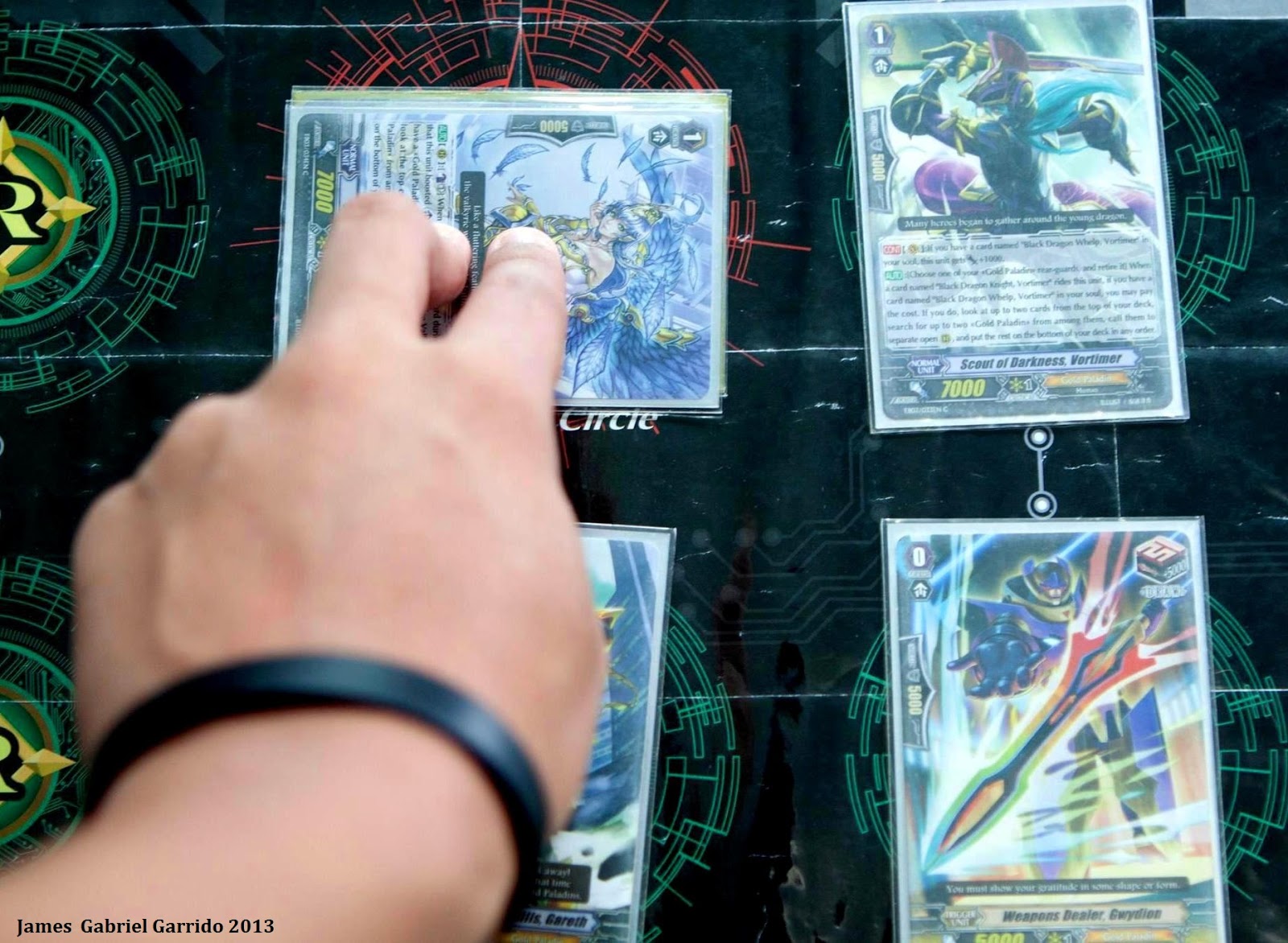
You can select a unit from your hand which has a grade that is equal to or greater than the grade of  the vanguard unit you have that is currently on your field. In this photo, “Blade Feather Valkyrie” (a grade 1 normal unit) rides over the grade 0 normal unit (the FVG), “Black Dragon Whelp, Vortimer”. You may or may not choose to ride during a turn.

MAIN PHASE


During the main phase, you may call as many units to your rear guard circles as rear guard units as long as the units that you are trying to call or summon to the field has a grade no greater than your vanguard unit.


BATLE PHASE

During this phase, you can engage your units to attack the opposing front row units that your opponent controls. Front row units (2 rear guards, and 1 vanguard) are the ones that will attack while backrow units support by adding their power to the unit directly in front of them, provided of course that the backrow units are grade 0 or 1 (or the units which have the ‘BOOST’ability).

Example:


“Blade Feather Valkyrie” is to attack.  To indicate that a unit is attacking, turn is sideways and then select the unit which will be the target of your attack.


“Knight of Elegant Skills, Gareth”, a grade 1 normal unit (which is placed directly behind the vanguard unit), boosts Blade Feather Valkyrie. Boosting also requires the boosting unit to rest and is also indicated by turning it sideways.


In this case, Gareth’s 8k attack power is given or is added to Valkyrie’s 7k attack power, totalling up to a 15k power line.  This process also applies to rear guard units whenever they attack too.


*DRIVE CHECK*

When you attack, your opponent is given the option to either guard or to not guard. When your vanguard unit attacks, after your opponent has decided the number of guards or what are the units which  he/she will be using to guard for your attack, you have the opportunity to drive check. When your [V]  unit attacks, you will check and see the top card of your deck  and then add it to your hand. If a trigger unit is drive checked, the effect is activated (provided that you have at least one unit on your field which is of the same clan as the card that is being drive checked).Only the vanguard unit is allowed to drive check. Trigger effects can be distributed separately to your units and not necessarily on one unit only. Lastly, trigger effects only last until the end phase of that particular turn. 


Valkyrie attacks with support from Gareth. Turn player checks the top card of his/her deck for a trigger:


Turn Player Drive checks a Draw trigger. He/She decides to give the +5k power boost effect to one of his [R] units and then draws a card.

After all battles have commenced, the turn player decides to end his/her turn. This is called the END PHASE.


B.) DURING YOUR OPPONENT’S TURN:
During your opponent’s turn, you are most likely just going to be sitting there, watching him/her make his/her combos while the only action you’re left to  (and only allowed to) do is guard and successfully survive all of his/her attacks. The only part of your opponent’s turn where you would be active is during (only) his/her battle phase – unless stated otherwise by a card effect. 


*GUARDING*

So when your opponent decides to attack, you have the opportunity to decide whether you will guard or not that particular attack initiated by your opponent. Often cases, you will be forced to guard in order for you to keep your damage to a minimum or have rearguard presence advantage (the more the better).
When you guard, you can select any number of units from your hand and/or any of the two (or both of the) grade 2 rear guard units in the front row (which have the intercept ability), and place them to the guardian circle. When you guard, make sure that total shield power value added to the unit you are trying to protect is more than the attack power of the unit that is attacking. This will ensure that the attack will not hit thus a definite protection to your unit. After that particular battle, units that were used to guard are then sent to the drop zone.

Example:


Player  B (Masquerade) decides to attack Player A (Valkyrie).


Masquerade has an attack power of 9000. With its drive check, it could possible that it can hit for 14,000.


Player A decides to guard. He/she guards with “Scout of Darkness, Vortimer” (left) and “Dantegal” (right).


Vortimer (5k shield) plus Dantegal’s (10k shield) shield power combined together sums up to a 15k shield power, enough to reassuringly guard masquerade’s attempted attack.

After all of your opponent’s attack he/she will end his/her turn  (End Phase) and it is your turn again.The same procedures will apply and be repeated for the rest of the game.

During your next turn, you are to stand your units, draw a card, and ride another unit the same or greater grade than your current Vanguard. 


Also, you may call again as many units as you opt to

When you’re trying to call a unit to a [R] circle and all the [R] circles have already been filled up or no [R] circle is open, you just simply Retire (or remove) the unit in the designated [R]circle and “replace” it with the unit that you want to call.

Example:


“Flash Edge Valkyrie” is placed on the [R] circle, and “Scout of Darkness, Vortimer” is retired and sent to the drop zone.

After a long game of wits and survival, when you have finally dealt six damages to your opponent, or you finally managed to drain out all the resources from his/her deck − casuing them to be unable to draw anymore cards – then you’ve won the game.


Spectral Duke Dragon delivered “Final turn” to the Shadow Paladins


*six (6) damages (end of game; gg)

So there you have it. Some more practice and you’ll be a good player in no time. It just takes a lot of perseverance and hard work in order to become better at playing this game. And always remember, that it is not in victory that power is attained, but it is in learning – especially in one’s losses. And thru learning, one will grow stronger and become better. And what’s the best part about this? There is never an end to learning.

Cardfight!! Vanguard Introduction: Part 3-A

Photo owned by Cardfight!! Vanguard USA (Bushiroad).  No copyright infringement is intended.

We’ve reached this part of the Introduction posts where in this post, we will be discussing about all the game mechanics that are needed in playing the game. This will be the last part of the tutorial posts which will be divided into two (2) parts, respectively: 1.) What is (and how to build) a deck, 2.) Playing the game itself.

So to begin with this, “what is a deck?”


A brief definition of this is that a deck is any number of cards − depending on that particular game − that are joined together to form or create one cohesive group. In Cardfight!! Vanguard, a player is ONLY allowed to have EXACTLY  FIFTY (50) cards in a deck.  There can only be a maximum of four (4) copies per card in that deck (unless stated otherwise in the Official Restriction List of Cards decreed by Bushiroad) and every deck should have exactly sixteen (16) trigger units (in any combination of the trigger types) and no more than four (4) of that can be heal triggers.

In building a deck (in Cardfight!! Vanguard), one must have to choose one (1) clan among the numerous playable ones that are available in the game. So why only one?  Albeit it’s allowed to play multiple clans in a deck, it’s because of the rule that trigger effects produced by the trigger units themselves can and will ONLY activate if and if only that player who drive trigger checked has a unit (that is of the same clan as the trigger that is being checked) that is currently on the battlefield . So if a player is playing multiple clans in the deck, then there will be lesser chances of successfully activating a trigger, resulting to the futility of the checked trigger card.

Some of the clans that are available in the game. All rights to this photo belong to their respective owners. No copyright infringement is intended.


Also, in a deck higher grade units are brought in lesser number compared to lower grade units. This is done to prevent being grade-screwed (or grade-locked ) by having clogged Grade 2 or 3 units in the hand thus being unable to ride to the supposed-to-be grade unit of your current vanguard on the field. It is often advised to copy or imitate the grade lineups that are listed on (and formulated by) the trial decks (it has been found and have been proven to be very effective), that is: 7 Grade 3’s, 12 Grade 2’s, 14 Grade 1’s, and 17 Grade 0’s (including of which is the FVG or the starting vanguard and the 16 others, the trigger units).

Photo owned by Cardfight!! Vanguard USA (Bushiroad).  No copyright infringement is intended.


So now that we know how to build a deck, it’s finally time for us to play that deck and have some fun competition with other players. But hold your horses, we’re still not finished. On the next post, we will discuss about playing the game and the mechanics that are ruled to the game. ‘Til next time, ciao.


-KamiPrince-