Thursday, September 19, 2013

A.V.D.: Blaster Spirits

Advanced Vanguard Discussion: Blaster Spirits

Photo owned by James Gabriel Garrido. Photo not to be used or be posted elsewhere without the consent of the owner.

Blaster Blade Spirit and Blaster Dark Spirit are two very unique cards which were introduced in set 9 (BT09 - Clash of Knights and Dragons). They both are in the same clan as their original versions and both have 10k in power.Blaster Blade Spirit is a Royal Paladin unit while Blaster Dark Spirit is a Shadow Paladin unit. And just as they were once grade 2 units, they still are in this version of theirs.

The skills of both Blasters are very similar in nature, differing only in the target that their skill are allowed to be applied. Their first skill is an [AUTO] skill which activates when either one of them is called to the Rear guard from the deck (or Superior called) and for the cost of ONLY one (1) counter blast, you get to retire an opponent's front row rear guard. Blade destroys a grade 2 or higher rear guard while Dark obliterates grade 2 or lower front row rear guard units. These two are best brought in a deck which revolves more on superior calling from the deck such as that of Pellinore builds. But what makes them really tough is that both of them have a huge base attack power of 10,000. This base power surpasses the 9k regularity of most grade 2 rear guards thus they are nerfed by their second skill. Whenever either one of them is attacked, then the blaster automatically dies despite if you guarded it.

What's more peculiar to this two is their third skill. A [CONT] Continuous skill which haves them two (2) treated as Gold Paladin cards. This is the very reason that these two are mixed in Gold paladin decks because they are 10k and they a skills which are more or less very strong and potent. But back to their "destroy-this-automatically-when-attacked" skill, it isn't really that big of a deal. Anyway, it could've been used to only intercept and losing it was already prepared for. Its their 10k base that makes them really big and painful.

Unfortunately though, only the Gold paladins have this kind of mini-support from other clans (Royals and Shadows). Other clans have no units such as these. It would've been better to see more of these kind of units. It is a unique perk that Bushiroad thought of, but only for Gold Paladins.


-kamiprince39-

Cardfight!! Vanguard:Brace yourselves, World Championships is coming


How is everyone doing? I hope all is well for all of you guys with regards to your Vanguard experience. Some might still be getting used to the game and I hope that each and everyone of you enjoy every moment of your learning experience (don't mind the bitter losers and the douchebag players that any of you might have played against along the way). Because that's the best part about this game; you keep on learning new things and in the process, you become stronger and better.


Anyway, Nationals for the Worldwide Qualifiers have officially begun just two (2) weeks ago with Toronto starting things off. Beast Deities (Nova Grapplers) grabbed the first victory for the Nationals, an impressive victory to the clan being that the clan itself is underhanded and that no one ever pays attention to it and looks at it in a competitive perspective. A week later, kageros (DOtE) burned the whole nationals tournament in Atlanta, Georgia and proved to take their place in the upcoming Continentals for the World Championships, winning against adversaries such as Golds and Narukamis. And in less than just 3 days away, Nationals in my country will be happening very soon. Unfortunately I can't join because I live far from the venue of the tournament and the final exams for my study is fast approaching. I would've wanted to at least spectate at the event, but unfortunately I just couldn't. 

Platina Ezel


I really expect to see a lot of Gold Paladins and Narukami The Bloods, seeing that they're the only decks that are really capable - and have a high chance of - winning the tournament with so much ease and efficiency. But with what Nova Grapplers did at Toronto, well it has become a bit of a question as to what clan will represent the Philippines for Worlds knowing that any deck can really win despite that particular deck's popularity. Novas were pretty much neglected then, but unexpectedly won as a "rouge"deck. 


 Azure Dragon


So what's the point of all of this? Well, I would strongly suggest that each one should really be motivated to watch and experience these tournaments. This is where high level gameplay is best exhibited and showcased;where the best among the bests come to gather and share their talent of playing the game and their philosophy with regards to playing a particular and the clan itself that they're running with for the Championships. I would even suggest that for a beginner, it is more advisable to watch and pay attention carefully to how these cardfighters play and demonstrate their skills of the game, that in so doing you learn new tips and tricks that is not just about harnessing your deck, but also learning the ways in approaching other clans and knowing what is their Achilles heel. Just like in real life, this game is just based in knowledge. If you know much, then it isn't really that much of a bother or an uncertainty when you play; it's really about learning. And that's the ultimate gift that this game can ever give anyone who plays it.


-kamiprince39-


Saturday, September 14, 2013

A.V.D.: Self-standing Vanguards

Advanced Vanguard Discussion: Self-standing Vanguards

Photo owned by James Gabriel Garrido (not to be used or to be posted elsewhere without the owner's permission)
It is a rule that Vanguard units are to remain at rest after they've attacked. Stand Triggers can only apply its restand effect on Rear guards. This is because if vanguards were to stand back up again, they could again attack and drive check twice. If this would've been the case, everyone might’ve been playing 8-12 stands instead of bringing multiple criticals. Some cards though, surpass this limitation. These units are able to restand themselves, and could attack once more.

The very first of its kind, Dragonic Overlord was the very first self-standing vanguard. It was released in both its trial deck and in set 1. This Demonic Beast unleashed the flames of hell itself upon those who would be foolish to oppose its superior power. An 11k beater, it’s just as big as it could get hitting 16k-21k power columns that proved to be so devastating to old grade 3 units whose average base attack powers were just 10k below. And that’s just its stats, his abilities have not been mentioned yet. At the cost of 3 counterblasts, this motherfucking dragon of mass and colossal destruction gets a continuous +5000 power until the end of the player’s turn. And that’s not all, when it hits an opponent’s Rear guard, its true power is revealed: IT STANDS BACK UP. It restands and all of the effects remain in it – provided also that its attack hits. And with this at hand, it would again look forward for another attack until ultimately all of the opponent’s resources have been burned to ashes. Of course there’s a catch to this though; it loses its Twin Drive ability yet it can still drive check 1 card when it attacks again.

But neglect the capability to drive check twice or thrice, what’s so dangerous about this beast is that it can still activate its skill while it is also in Rear guard (no drive checks though). A rear guard that is almost as strong and as good as the vanguard is such a huge plus for any player.

Later sets then tried to imitate the signature skill of Dragonic Overlord most notably its crossride, DragonicOverlord “The End”. What differed between the two was that “The End” required a cost of persona blast. BT04 also released Stern Blaukluger which also has a skill similar to Overlord, that when it hits it can stand back up.  EB03 also released a vanguard similar to Overlord but with an easier condition to pull-off: Spectral Duke Dragon.

Photo owned by James Gabriel Garrido (not to be used or to be posted elsewhere without the owner's permission)
Spectral Duke Dragon is a 10k Vanguard. While “Black Dragon Knight,Vortimer” is in the soul, it gets a continuous +1000 power. But that’s not what’s scary about it. Just like Overlord, it too can stand back up on its own, for the price of 2 counterblasts and 3 Rear guards. What edge it has over Overlord is that during the end of the damage step that it attacked (regardless if its attack hit or not), its Limit Break allows it to restand itself back up, retaining all the effects of power boosts and extra criticals that it gained during its drive check. It does lose its twin drive though, yet still the ability to choose whether or not to restand yourself back is already a very destructive skill.

Not to mention also that this was also the main vanguard unit of Brandon Smith’s Gold Paladin deck which won the World Championships 2012 last year. He ran this build instead of the normal Ezel deck and showcased to the world how strong and effective this deck really is. Another testament added to how devastating and dangerous these type of vanguards are. 


-kamiPrince39-


A.V.D.: 8K Vanillas


Advanced Vanguard Discussion: 8K Vanillas
Photo owned by (c) James Gabriel Garrido 2013, not to be reposted elsewhere without the original photographer's express permission.
8k vanillas have always been a staple for every deck. These were the units that gave so much consistent boost for front row units (they are even good front row Rear guards). This is because of their high base attack power for just being a grade 1 unit. And (f.y.i.) the reason why people call these cards “vanillas” is because of their skill-less existence. In short, they have no skills/effect whatsoever. That is why (maybe) that they have high attack power in order to compensate for having no skills – or it could be the other way around. Either way, they’ve proven their worth in every player’s deck through the past time.

But I’ve been noticing lately that players (in Japan) are now dropping these units out from their decks and are being replaced by 7k units whose skills are worth playing. Such example is seen in the Shadow Paladins. Naturally, Shadow Paladin players would opt to bring with them 4 Charons. But in the new Revengers build, there is no more Charon to be seen. Instead, it has been replaced by Dorin, a 7k grade 1 unit which works really well with Blaster Dark Revenger. It unflips a flipped damage in the damage zone when Blaster Dark Revenger is placed in the Rear guard column directly in front of him. This makes Blaster Dark Revenger's counter blast-2 skill look like a counter blast-1 skill. This is just so effective that no one would think twice of bringing four (4) of him.

This is very understandable though. Why would anyone bring a mediocre card (8k vanilla) − who serves no purpose other than boosting  − instead of bringing a unit which is more useful for powerplays (and when the difference between the two (2) units is just 1000)? It is then worth knowing about these cards (this might also be the reason as to why the 8k vanillas didn’t get to be reprinted as newer versions during the rise of archetypehood of the meta).Whatever the reason may be, these cards are being now being left behind. Some players will just bring these just to fill up the empty space in their deck.

Is this another part of the evolution of the meta? Another step towards a higher plain of gameplay? Perhaps; who knows. But there is a clear indication of change. That these units are now disappearing and that also in the future, maybe there will be no more 10k vanillas.Still, being very consistent in nature, they still signify their essence. Albeit they are being dropped, they are still "ok" cards to bring in a deck.


-kamiprince39-

Friday, September 13, 2013

Vanguard 101: Ride chains

Ride Chains
Vortimer-SDD ride chain (Gold Paladins)
Photo owned by James Gabriel C. Garrido. This Photo is not to be used elsewhere without the owner's permission.
Grade line-ups of a deck is a very crucial aspect in playing Vanguard.  Higher grade units are brought in lesser number compared to lower grade units in order to prevent being unable to ride to the next grade (or what is informally called as being “grade screwed” or “grade locked”). However, in set 3 (BT03-Demonic Lord Invasion) a new mechanic known as Ride chain was introduced – wherein Tsukuyomi  (OTT) and Gallahad (Royal Paladins) acted  as the pioneer ride chains.   Later sets then integrated the said mechanic and transformed the build of already existing clans.

Basically a Ride chain is series of evolutionary grade line-up which is meant to be ridden on top of the former (grade). This type of riding provides accessibility to the next grade unit of the current vanguard on the field. Essentially speaking, they secure grade-ride assurance, making sure that the player doesn’t miss a ride and prevent being grade screwed. When the grade 0 is in the soul, the grade 1’s attack is 8000. When the grade 1 is in the soul, the grade 2 becomes 10000. And when the grade 2 is in soul, the grade3 becomes 11000.

As of today (September 2013), there are currently four (4) types of Ride chains: the first, being Tsukoyomi and Gallahad in set 3; the second, the being Blasters (Shadow Paladin), Blaus (Nova Grappler), Amber Dragon (Kagero), Enigman (Dimensional Police), and Giraffa (Megacolony); the third (introduced first in EB02), Riviere (Bermuda Triangle), Vortimer-SDD (Gold Paladin), Magatsu (Murakumo), Ergodiel (Angel Feather),etc; and last, the current ride chains of japan which are Artemis (Genesis), Ripple-Genovious (Aqua Force), and Schwarzschild (Link Joker).

The first type of ride chain consisted of checking the top five (5) cards of the deck for the next unit in the chain and if it is there, it is superior ridden. Additionally, they lose 2000 power if not all of the parts of the ride chain is found in the soul. This -2000 was such a pain for it isn’t really guaranteed that much of getting the next unit for the chain.

The second type was released in set 4 and consisted of having to draw the grade 1 unit in the chain and riding it on top of the grade 0 to search for the grade 2 unit of the chain. The grade 1 (when placed in Rear guard) can then search for the grade 3 of the chain by simply discarding a grade 3 from the hand.  This offered a more secure ride opportunity for players albeit was still inconsistent in the sense that the player relied to much on the grade 1 ride.

The third type  (and the more famous type of ride chain amongst current ride chains i.m.o), which was released first in EB02 has the grade 0 search for either the grade 3 or grade 2 unit of the chain (by checking the top 7 cards of the deck) when the grade 1 unit is ridden on top of it. Despite the increase in the number of cards checked on top, this was still too hard pull off for the player had to have the grade 1 and either the grade 2 or grade 3 unit of the chain in his/her hand, so that the player will just only be looking for the third and last piece of the ride chain when the seven (7) top cards are checked. This was the fastest build though.

The last type of ride chain is more or less similar to the third type (which was introduced in set 10). What it differs in, is that when you miss to ride your grade 2 (or when you ride a grade 2 unit other than that of your chain), you have the chance to check again the top seven (7) cards of your deck and if the grade 2 unit of the chain is there, superior ride it. This was the most aggressive type of ride chain to have ever existed. This ensured the players that their grade 3 vanguards would be 11k.

The problem with ride chains though is that you will (more or less) rely on this skill. This then becomes a major weakness to you and it becomes your only way to win games. That when you don’t successfully accomplish your ride chain, your vanguard becomes a sitting duck. On a personal preference, I would highly advise no to go with this. Non-ride chain decks are more versatile and more flexible in nature, not a one-trick pony like most ride chain decks are. 


-kamiprince39-

A.V.D.: The Drive Quartets (Bermuda Triangle)

Advanced Vanguard Discussion - Bermuda Triangle: The Drive Quartets

Photo owned by Cardfight!! Vanguard Bushiroad. All rights belong to their respective owners. No copyright infringement intended.
The release of EB02 Banquet of Divas gave way for the debut of the Bermuda Triangle clan. It introduced the Riviere ride chain for the clan and several other Bermuda triangle cards. The clan then later received more support when EB06 – Dazzling Divas was released (just last July 26, 2013), including their Breakride support PRISM Image Vert , making them the very first clan to introduce the Breakride mechanic in the English format. But set aside all the general discussion of the deck, and let’s discuss about a perk (as how I like to call it) of the clan that isn’t really utilized that much by most players: The Drive Quartets

“The Drive Quartets” is a sub-archetype of the Bermuda Triangle clan. Unlike most sub-archetypes though, they are not normal units.  Instead, they are a of group triggers of their clan whom each has a similar skill to other. What each of them basically does is that each of them gains +3000 power when a specific drive quartet unit is present as your Rear guard.


Shuplu gains +3000 power if Bubblin is in Rear guard; 


Flows gets the +3000 if Shuplu is present in the Rear guard


Bubblin gets +3000 power if one of your Rear guards is Ressac


Ressac gains +3000 if Flows is one of your Rear guards.


 It’s just cyclic in shape. Its presumable then that if all four (4) of them are present in your Rear guard circles, then each of them is a 7k unit.

So what is the essence of this? We’ll thats because of the fact that they ARE triggers. Remember that after triggers have been used from drive checks, they just become your guards in hand. They prove not that much of use anymore, even their 5k boost is not that good. Also, there are those times which you just keep on drawing triggers, and you just have no other units to call for your offense because their 5000 power is just that good enough.

But, with these ladies though, you are able to get a +1 from your predicament. Instead of them just being guards in your hand, you can now use them as alternative boosters or as offensive units.  Albeit 7000 as an attack is not really that good, its the idea of them being flexible that gives them their quiddity. They can both be used as guards, and at the same time be reserved units for later game-pushes.

What‘s more to this is that they are the ONLY ones (clan) that have this kind of perk. No other clan has this. A unique mechanic that could later be harnessed and be utilized further in the future of the game. 


-kamiprince39-

Thursday, September 12, 2013

Vanguard 101: Crossrides

Crossrides

"Swallow everything in your darkness, Abyssal Despair!!"
(Photo owned by James Gabriel C. Garrido. This Photo is not to be used or be posted elsewhere without the owner's permission.)
Grade 3 11k base attack vanguards have proven their supremacy and dominance over those which are inferior to them throughout the game. These  units can reach 16k-21k – or the so called magic numbers – power line, alone in their column without even being boosted (yet).  Despite the mediocrity in the skills of some, their high base attack power provides resiliency and fortitude for the player using them.

When Set 5 (BT05 - Awakening of TwinBlades) was released last February 2013, it introduced new grade 3 11k vanguards, two (2) of which were the very overhyped and long-awaited units to be first released in their English format, namely: Dragonic Overlord “The End” <Kagero> and Phantom Blaster Overlord <Shadow Paladin>. These new units came to be known as “Crossrides”, with the two being the very first of their kind. Succeeding sets then provided other clans their very own crossrides (and it would seem that Bushiroad is advertising this gimmick to form a metagame composed of crossrides). BT09 Clash of the Knights and Dragons then gave more crossride support for Aqua Force, Narukami, Gold Paladin, and Oracle Think Tank. Later sets (which are still in Japanese and have not been released in English yet) of BT12 – Binding Force of the Black Rings and BT13 – Catastrophic Outbreak brought more crossride support to already pre-existing clans.

So what are CROSSRIDES?

The very first attribute that crossrides have (that other grade 3 units don’t) is that they can have an active and continuous base attack power of 13,000, provided that a specific unit is found to be in the soul.  They are 11k vanguards that gain 2000 more attack power when the required certain unit is in the soul (e.g. “Phantom Blaster Overlord” can only achieve his +2000 power when “Phantom Blaster Dragon” is in the soul). This is the only prerequisite that these units need in order for them to achieve such power. Basically, without the required unit in the soul, they are just 11k vanguards but are still very bulky and are still very resilient ion nature.

 Having that huge base power of 13,000 is very hard for an opponent (whose not playing a crossride) to deal against. This skill enables the vanguard to surpass the ‘so-called magic numbers’ and extend up to 18k-23k power columns (without even being boosted yet), and force the opponent to guard with more units from his/her hand or from his/her front row rear-guards, ultimately draining and wasting all of his/her resources . And when there is a depletion of “resources” (units other than the Vanguard), there will be two (2) predicaments that any player will likely and unfortunately be facing: 1) Fewer number of units can used to guard against the opponent’s attacks, 2) Lesser number of units can be called to rear guards. No one ever wants to have themselves in either of these situations.

Why did crossrides exist?

To be honest I really don’t know, except the fact that they were the last and ultimate units of the main antagonist and the ‘second’ protagonist to be featured in the animated show of the card game. It would seem to be as an advertising strategy by Bushiroad to sell “very strong cards in the game” which would presumably make huge sales and has now lead to form the shape of the current metagame. Now, the meta is just composed of crossrides (especially in Japan wherein BT12 released several new crossride support to already pre-existing clans such as Palemoon and Dark Irregulars).

With the current sets bringing more Crossride units, the meta of the game is surely to be seen with more powerplays and the level of competition has been revved up to a higher level. Players will now have to adapt to this kind of play and will be forced to run crossride decks in order to cope up with the meta. In so far as the meta is to be concerned with these crossrides, it is predicted that this mechanic will surely prove to be a stepping stone to the future mechanics of the game, another seed which will soon give rise to new kinds of plays and power.


-kamiPrince39-

Tuesday, August 20, 2013

Vanguard 101: Limit Break

Whenever you are already down to five damage, it seems that hope is already lost and that there’s only a very thin chance of you turning the tide of the game and eventually winning it.  This is a predicament that any player would never want to be in. Fortunately, there came the mechanic of Limit Break. 

Photo owned by James Gabriel C. Garrido. This Photo is not to be used or be posted elsewhere without the owner's permission.
What is “Limit Break”?

The mechanic of Limit Break was first introduced when TD05 (Slash of Silver Wolf) and TD06 (Resonance of ThunderDragon) were released, together with BT06 Breaker of Limits. The two trial decks, which consisted of (and the debut of) the Gold Paladin clan (TD05) and the Narukami clan (TD06), were the very first clans to ever have the Limit Break mechanic and too, were the very first ones to use it in competitive play. Later sets then followed and gave Limit Break units to already existing clans and further expanded the meta of the game.

Limit Break is a mechanic of the game that enables a player to fully utilize the damage predicament of a player. It is a strong and dangerous ability which turns “good” vanguard units into devastating and destructive forces. What it does is that when a player is at four damage, an ability or skill becomes active. Usually these Limit Break skills are very broken or overpowered. Because of which, Limit Break grants the player a chance of still winning a game despite of the near loss situation that that player is maybe in. Cards like Blonde Ezel or Dragonic Kaiser Vermillion are such examples of units that are very dangerous when at Limit Break.

Of course there’s also a downside to this. Some units such as Spectral Duke Dragon are only strong and dangerous when their Limit Break is active. Otherwise, they are just vanguard units that remain there activating no skill whatsoever until only the player is at four damage. Waiting to be damaged doesn’t really sound as rational as it should be, knowing that you have to win as fast as you can and grab every opportunity that you are able to, to break your opponent badly.

But majority of these units (which have Limit Break) are in overall effective and dangerous. These cards can guarantee victory provided that they are also used properly and at their full potential. Limit Break has proven to be one of the factors that could affect how a deck totally works, and in a bigger view, how players win by them. So break past your limits and surpass thy boundary!


-kamiprince39-

Vanguard 101: Perfect Guards


Greetings fellow card fighters. Today we will be discussing about a type of card which is essential in playing better at this game. We will be discussing all about PERFECT GUARDS.

Photo owned by James Gabriel C. Garrido. This photo is not allowed to be used or be posted elsewhere without the owner's permission.

So what are Perfect Guards basically? Well, Perfect Guards or PG’s (as their title implies,) provide “PERFECT” or absolute DEFENSE or SHIELD. They are indicated by the Zero (0) numeral value on their shield icon (and are now distinctively distinguished by the gold shield which started post set 8 until the current sets) and all are RR in rarity. All Perfect guards so far are Grade 1 normal units with their normal boost ability and have 6000 base attack power. All PG’s also have the same cost (discard 1 card from your hand with the same clan as this unit) and only up four (4) copies of cards which have “sentinel” ability can only be brought in a deck.

(FUN FACT: “Perfect Guards” aren't officially called as it is by Bushiroad. They are formally known by the company to be “Sentinels” (the name of their ability indicated on their skill). In the animated series, they are called “Null Guards”. The former was only coined by players yet is now formally recognized in the Japanese animated series as the universal title (maybe due to its already tolerant popularity).

So what is the essence of these cards?

Well let us explain. When you guard against an opponent’s attack, it takes up so much units in your hand to be used as guards just to ensure that your opponent’s attack doesn't hit. Each turn you are losing more and more cards, while you only get to draw 2-3 cards per turn with your normal draws and drive check. This causes hand-card disadvantage and hand-card disadvantage is a huge factor in the game which can bring you to your own demise. Even with having abundant hand cards, players still need to play conservatively.

With Perfect Guards though, instead of losing 3-4 cards in guarding against an attack, you only lose 2 cards: the Perfect Guard itself and the card discarded for its cost. And what’s best about it is that it IS assured that the attack will not hit, unlike normal guarding which wastes so much and yet there’s still a chance for the attack to pass through if the attacking vanguard hits triggers and surpasses the total shield of the opponent. PG’s then offer two advantage points: 1.) Ensured protection, and 2.) Conserved hand-card advantage.

Perfect Guards, albeit useful and efficient, also impose a disadvantage factor to the player running it in his/her deck. 

Photo owned by Cardfight!! Vanguard Bushiroad (via ideal808.com). All rights belong to their respective owners. No copyright infringement intended.

In some decks, such as that of Blade Wing Reijys (Dark Irregulars) whose primary focus is to soul charge units to bulk up the soul and win games with their skills which are heavily based on soul quantity, PG’s provide only obstruction in the strategy of the deck. These builds carry only (if not all, then maybe most) cards which help in bulking up the soul to finish games quickly. PG’s which only provide absolute protection and have no assistance whatsoever in soul-feeding, will only slow down the pace of these decks and thus could even cause the loss for the player. This is the reason that some decks only bring 3 copies or none at all.

Also, if Perfect Guards are bought singly or online, these cards cost so much! These cards are very darn expensive due to their scarcity and very-hard to find nature in packs. This results in the inaccessibility of a player to it which is negatively appreciated.

Still, Perfect Guards are considered to be one of the very essential cards in playing the game. Despite their big price tags, they still provide convenience and efficiency especially during late games and there are only a small number of cards left to be played. Perfect guards are then still recommended. 


-kamiprince39-

Monday, August 12, 2013

Cardfight!! Vanguard Introduction: Part 3-B

Let's play some Vanguard!

At last, we are finally on the verge of finally being able to play the game. This will be the last post regarding the tutorial essences necessary in playing the game and in the succeeding posts we will formally be talking about in-depth analyses and discussion of certain aspects regarding to the game.


To start with, both players place their FVG’s  to their respective Vanguard circle face-down. Players then must decide on who will be playing first by rolling a die, or by rock-paper-scissors, or any other method that both players would agree to. After this has been decided, both players draw five (5) cards from their respective decks (note: during only the first turn, a player may opt to reshuffle any number of cards that that player drew and can draw again the same number of cards that he/she returned to the deck; also called a mulligan). Both players then Stand their Vanguard by flipping it face up. So basically, what happens in a turn? We’ll start off with ‘your’ turn.


During a turn, there are several phases that occur and each of these phases has a corresponding actions that is to be done so. The first phase during a player’s turn is the Stand phase or the phase where the turn player stands his/her Vanguard. Next to this phase is the Draw phase where the turn player draws a card from his/her respective deck, after which is the Ride phase followed by the Main phase. The Ride phase is that part of the turn where the turn player may opt to or not to ride a unit that is of equal or higher grade than the Vanguard unit currently present on his/her field, and the Main phase is where the turn player is given the opportunity to call or summon forth units (that are equal or lesser in grade to the Vanguard unit) to the five (5) Rear Guard circles.

The last phase in a turn is the Battle phase – although no battle phase can occur during the first turn of the game – where the turn player has the opportunity to attack the opponent’s front row units. Note that during a battle, only the front-row units can attack and be selected as attack targets (and only the front-rear guards are allowed to intercept). Units in the back row only provide support and attack boost (grade 0 or 1 units). After a unit has attacked, that unit is put to rest (indicated by putting it sideways) and  after a rear guard unit is attacked and hit, that rear guard unit is sent into the drop zone. When all the battles have been commenced, the turn player now ends his/her turn (or is in the End phase of the turn) and the same phase pattern is to be followed by the opponent.

You win the game when you've already dealt equal to or more than six (6) damage to your opponent or when your opponent is unable to draw any more cards from his/her respective deck during his/her normal draw on his/her draw phase. This is also called a deck-out.

EXTENSION: Detailed and thorough Demonstration of the game

The Field positions


a.) Vanguard circle [V]– this is where the Vanguard or the main unit (the axis) of the deck is placed into. Units in the vanguard circle cannot be removed at any time during the game. Units that are underneath the vanguard unit are called the soul.

b.) Rear Guard circles [R] – or the circles that units other than the vanguard are put into and these units provide support to the main unit (the vanguard). Front row rear guard units can attack and be attacked by the opponent’s front row units. Back-row units however, cannot attack or be attacked (unless stated otherwise) by opposing units. Rear guard units that are located on the sides can move or switch places with the Rear guard unit that is directly in front of them(this process can be repeated for as many times during the game as long as it is your turn).

c.) Guardian circle [G] – or the circle where units that are used to guard are placed into.  After that particular battle, units used to guard are sent to the drop zone.

d.)  The Drop zone – the part of the field where units from rear guard circles (after being hit) and units from the guardian circle (after being used to guard) are sent to or are discarded to.

e.) Deck zone – or the zone where the deck is put to. If in any case a player has no more cards to draw (during his/her turn’s draw phase), then that player loses the game.

f.) Trigger zone – or the area where the drive/trigger checked card is revealed

g.) Damage zone – whenever a player’s vanguard unit is hit by an opponent’s attack, the player checks the top card of his/her deck for a trigger (and if it is, the trigger effect is applied) and then sends that card to the damage zone. If the opponent has exactly or more than six (6) damage, then that player loses the game.


 A.      DURING YOUR TURN:


Place FVG on the Vanguard Circle (face-down)

STAND PHASE

(Shout “Stand-up, the VANGUARD!!!!”)

Stand your Vanguard  and then draw 5 cards. You may or may not choose to mulligan. This is then followed by your DRAW PHASE where you get to draw the top card of your deck.

RIDE PHASE


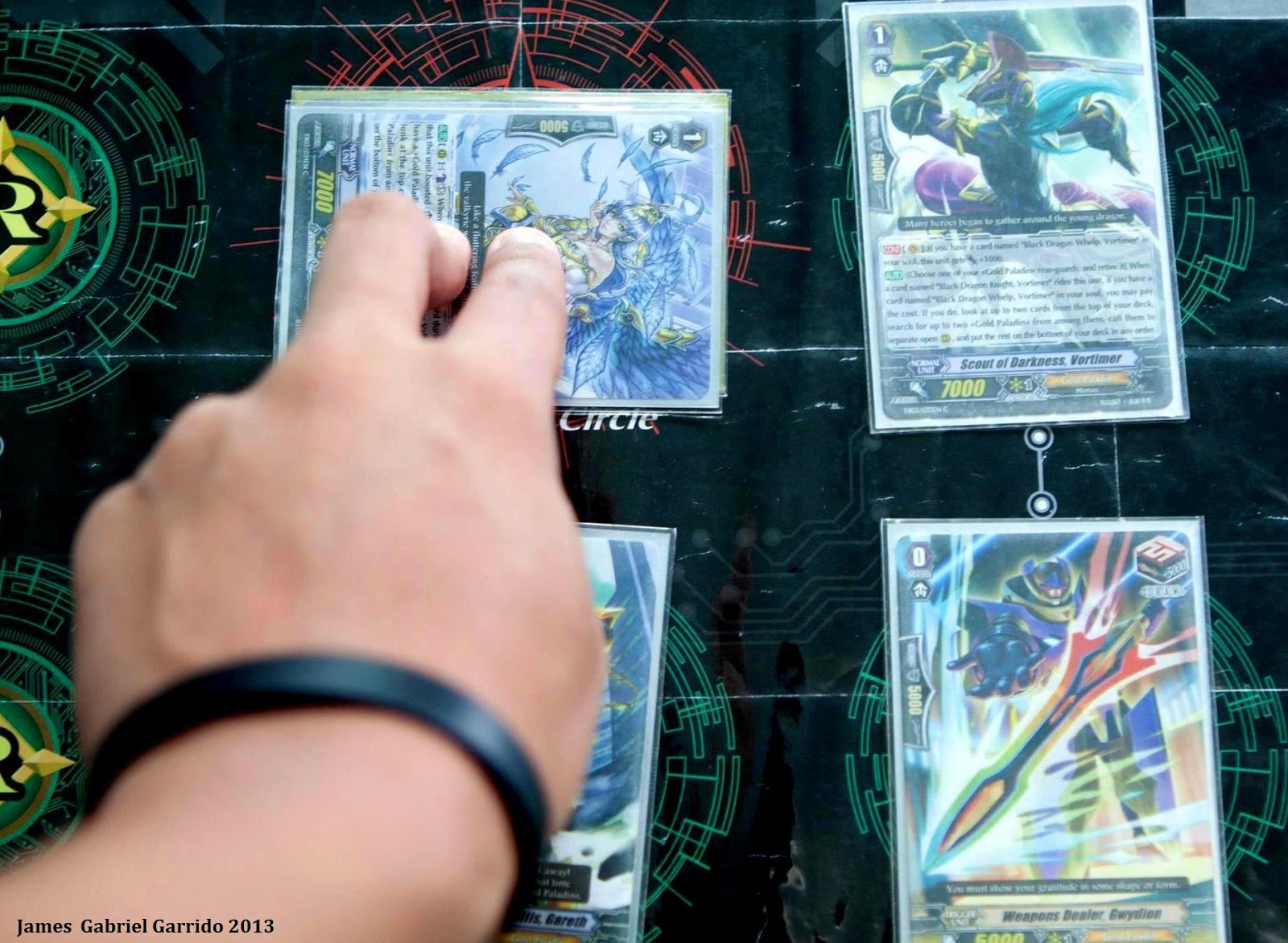
You can select a unit from your hand which has a grade that is equal to or greater than the grade of  the vanguard unit you have that is currently on your field. In this photo, “Blade Feather Valkyrie” (a grade 1 normal unit) rides over the grade 0 normal unit (the FVG), “Black Dragon Whelp, Vortimer”. You may or may not choose to ride during a turn.

MAIN PHASE


During the main phase, you may call as many units to your rear guard circles as rear guard units as long as the units that you are trying to call or summon to the field has a grade no greater than your vanguard unit.


BATLE PHASE

During this phase, you can engage your units to attack the opposing front row units that your opponent controls. Front row units (2 rear guards, and 1 vanguard) are the ones that will attack while backrow units support by adding their power to the unit directly in front of them, provided of course that the backrow units are grade 0 or 1 (or the units which have the ‘BOOST’ability).

Example:


“Blade Feather Valkyrie” is to attack.  To indicate that a unit is attacking, turn is sideways and then select the unit which will be the target of your attack.


“Knight of Elegant Skills, Gareth”, a grade 1 normal unit (which is placed directly behind the vanguard unit), boosts Blade Feather Valkyrie. Boosting also requires the boosting unit to rest and is also indicated by turning it sideways.


In this case, Gareth’s 8k attack power is given or is added to Valkyrie’s 7k attack power, totalling up to a 15k power line.  This process also applies to rear guard units whenever they attack too.


*DRIVE CHECK*

When you attack, your opponent is given the option to either guard or to not guard. When your vanguard unit attacks, after your opponent has decided the number of guards or what are the units which  he/she will be using to guard for your attack, you have the opportunity to drive check. When your [V]  unit attacks, you will check and see the top card of your deck  and then add it to your hand. If a trigger unit is drive checked, the effect is activated (provided that you have at least one unit on your field which is of the same clan as the card that is being drive checked).Only the vanguard unit is allowed to drive check. Trigger effects can be distributed separately to your units and not necessarily on one unit only. Lastly, trigger effects only last until the end phase of that particular turn. 


Valkyrie attacks with support from Gareth. Turn player checks the top card of his/her deck for a trigger:


Turn Player Drive checks a Draw trigger. He/She decides to give the +5k power boost effect to one of his [R] units and then draws a card.

After all battles have commenced, the turn player decides to end his/her turn. This is called the END PHASE.


B.) DURING YOUR OPPONENT’S TURN:
During your opponent’s turn, you are most likely just going to be sitting there, watching him/her make his/her combos while the only action you’re left to  (and only allowed to) do is guard and successfully survive all of his/her attacks. The only part of your opponent’s turn where you would be active is during (only) his/her battle phase – unless stated otherwise by a card effect. 


*GUARDING*

So when your opponent decides to attack, you have the opportunity to decide whether you will guard or not that particular attack initiated by your opponent. Often cases, you will be forced to guard in order for you to keep your damage to a minimum or have rearguard presence advantage (the more the better).
When you guard, you can select any number of units from your hand and/or any of the two (or both of the) grade 2 rear guard units in the front row (which have the intercept ability), and place them to the guardian circle. When you guard, make sure that total shield power value added to the unit you are trying to protect is more than the attack power of the unit that is attacking. This will ensure that the attack will not hit thus a definite protection to your unit. After that particular battle, units that were used to guard are then sent to the drop zone.

Example:


Player  B (Masquerade) decides to attack Player A (Valkyrie).


Masquerade has an attack power of 9000. With its drive check, it could possible that it can hit for 14,000.


Player A decides to guard. He/she guards with “Scout of Darkness, Vortimer” (left) and “Dantegal” (right).


Vortimer (5k shield) plus Dantegal’s (10k shield) shield power combined together sums up to a 15k shield power, enough to reassuringly guard masquerade’s attempted attack.

After all of your opponent’s attack he/she will end his/her turn  (End Phase) and it is your turn again.The same procedures will apply and be repeated for the rest of the game.

During your next turn, you are to stand your units, draw a card, and ride another unit the same or greater grade than your current Vanguard. 


Also, you may call again as many units as you opt to

When you’re trying to call a unit to a [R] circle and all the [R] circles have already been filled up or no [R] circle is open, you just simply Retire (or remove) the unit in the designated [R]circle and “replace” it with the unit that you want to call.

Example:


“Flash Edge Valkyrie” is placed on the [R] circle, and “Scout of Darkness, Vortimer” is retired and sent to the drop zone.

After a long game of wits and survival, when you have finally dealt six damages to your opponent, or you finally managed to drain out all the resources from his/her deck − casuing them to be unable to draw anymore cards – then you’ve won the game.


Spectral Duke Dragon delivered “Final turn” to the Shadow Paladins


*six (6) damages (end of game; gg)

So there you have it. Some more practice and you’ll be a good player in no time. It just takes a lot of perseverance and hard work in order to become better at playing this game. And always remember, that it is not in victory that power is attained, but it is in learning – especially in one’s losses. And thru learning, one will grow stronger and become better. And what’s the best part about this? There is never an end to learning.